
'Covid-related claims were almost 2.5 times the normal claims size.'

A day after the Reserve Bank of India (RBI) lifted its ban on HDFC Bank on issuing new credit cards, the country's largest private sector lender on Wednesday said it had resources and plans in place to "further reinforce pole position in the credit card segment" and that it would "come back with a bang". "We will aggressively go to the market, with not just our existing suite of credit cards but also new offerings in the form of co-brands and partnerships," Sashidhar Jagdishan, managing director and chief executive officer of HDFC Bank, said in a letter to his employees. The bank's management had earlier indicated that the lender had been sourcing liability customers aggressively over the past few months.

In an indication of easing financial stress among borrowers, the number of unsuccessful auto-debit requests through the National Automated Clearing House (NACH) platform declined in July, reversing a three-month trend that started with the second wave of the Covid-19 pandemic. According to the NACH data, of the 86.4-million transactions initiated in July, 33.23 per cent, or 28.7 million transactions, failed, while 57.7 million were successful. Compared to June, this is a significant improvement in bounce rates.
The Reserve Bank of India (RBI) on Wednesday gave banks time till October 31 to comply with its guidelines on current account and overdraft facilities. The central bank indicated that it was in no mood to change the proposed rules, but would only allow for stretching the timeline for smoother implementation. The initial deadline had ended on July 31, leading to thousands of current accounts being closed or frozen by banks. Lenders had requested the RBI for some more time to resolve the operational issues in implementing the provisions of the August 2020 circular in letter and spirit.

Unified Payments Interface (UPI), the flagship payments platform of the National Payments Corporation of India (NPCI), made a record in volume and value of transactions in July as digital payments rise in the pandemic. UPI processed a record 3.24 billion transactions in July up 15.7 per cent from June when it processed 2.8 billion transactions. In value terms, in July, the platform processed transactions worth Rs 6.06 trillion, up 10.76 per cent from June.

The non-life insurance industry has received over 1 million Covid-related claims in the first quarter of the current fiscal year (Q1FY22), higher than in the entire FY21, indicating the severity of the second wave of the pandemic. According to the General Insurance Council data, which is not publicly available, non-life insurers have received 1.22 million Covid-related claims so far in FY22 and have settled 944,573 of those worth Rs 9,178 crore. In comparison, they had received 986,366 Covid claims in FY21 and settled 849,034.

The Reserve Bank of India (RBI) on Wednesday allowed payment system providers, prepaid card issuers, card networks and white label ATM operators access to its Centralised Payment Systems (CPS), such as real time gross settlement (RTGS) and National Electronic Fund Transfer (NEFT) systems in the first phase of its plan bring non-banks in the same platform. "Direct access for non-banks to CPS lowers the overall risk in the payments ecosystem.

State Bank of India, HDFC Bank, Kotak Mahindra Bank, and IDFC Bank have filed a petition against the notice, in a last-ditch attempt by the banking system to keep the information confidential. The notice was given to the lenders under Section 11(1) of the RTI Act, seeking third-party disclosure requirements. While the apex court's original directive in 2015 applied to the full report, it was subsequently agreed that not the entire report but only relevant portions, such as those on bad debts and borrowers, would be made public.

'We are very watchful about inflation and growth. But the main challenge is economic revival and growth.'
'A strong foreign exchange reserve is the best safety net against global spillovers.'

The Reserve Bank of India's (RBI's) move to ban Mastercard from issuing new cards for not complying with the local data storage guidelines may hit five private banks, a non-bank lender, and a major card-issuing company. The impact is expected to be felt for a few months as these players transition to other card networks. According to Nomura Research, RBL Bank, YES Bank, and Bajaj Finserv are the ones most impacted by the ban as all their credit card schemes are allied to Mastercard. Among others, IndusInd Bank, Axis Bank and ICICI Bank have 35-40 per cent of their credit card schemes tied to Mastercard, the report said.

Unified Payments Interface (UPI), the flagship payments platform of the National Payments Corporation of India (NPCI), touched a record high both in terms of volume and value of transactions in June after a slump in April and May. The platform recorded 2.8 billion transactions worth Rs 5.47 trillion in June, up 10.6 per cent in volume terms and 11.56 per cent in value terms over May. This is in sync with the opening up of the economy as Covid cases gradually came down from its peak in mid-May and lockdowns were eased in various places.

After facing multiple outages that irked the regulator, the country's largest private sector lender, HDFC Bank, is revamping its technology infrastructure by making large scale investments, wherein it is bringing new talent, getting into cloud-native stacks, a shift from the traditional monolithic IT infrastructures, and working with strategic partners for better products and services. The bank management is clear that it will do whatever it takes in line with its growth path to ramp up its technology infrastructure.

'The overall death claims have gone up.'

The National Company Law Tribunal (NCLT) has approved the resolution plan of Twin Star Technologies -- a promoter entity of the Vedanta Resources group -- for the Videocon group. But it has pointed out that the successful resolution applicant is "paying almost nothing" as the amount offered is only 4.15 per cent of total outstanding claim. It noted the hair cut for all the creditors is 95.85 per cent and suggested to both committee of creditors (CoC) and the successful applicant an increase in the payout.

High inflation print is the price that the Reserve Bank of India (RBI) will have to pay to nurse a fragile growth back, say economists. Wholesale Price Index-based inflation rose to a record high of 12.94 per cent in May, aided by low base effect, but also because of higher fuel and commodity prices. Retail inflation, too, surprised by rising to 6.30 per cent, while the core inflation, which is the non-food and non-fuel component, rose to an 83-month high of 6.55 per cent. These numbers are much above RBI's upper limit of 6 per cent inflation target, but there is very little that the RBI can do at this moment.

Auto-debit payment bounces have gone up for the second consecutive month in May, emphasising the stress building up due to a halt in economic activities as authorities lock down various parts of the country to stop the spread of the virus in the second wave. According to the National Automated Clearing House (NACH) data, in May, of the 85.7 million transactions initiated, 35.91 per cent, or 30.8 million transactions, failed.

The Mumbai Bench of the National Company Law Tribunal (NCLT) on Monday approved Piramal Group's resolution plan for the beleaguered Dewan Housing Finance Ltd (DHFL), which has been reeling from the insolvency process since 2019. The plan put forward by Piramal Group, which has offered to pay Rs 37,250 crore, has been approved by the committee of creditors (CoC), the Reserve Bank of India (RBI), and the Competition Commission of India (CCI).
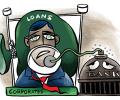
Public sector banks, including the country's largest lender State Bank of India (SBI), have come out with a templated approach for restructuring retail and small business loans of up to Rs 25 crore under the Reserve Bank of India's (RBI) Covid restructuring package 2.0. They have also come out with standardised products to make funds available to business entities for improving healthcare infrastructure and to individuals for meeting Covid treatment expenses. Business loans have been divided into three categories.
 © 2026 Rediff.com - Investor Information - Advertise with us - Disclaimer - Privacy Policy - Sitemap - Feedback - About us - Terms of use - Grievances